Can another designer legally use the same gameplay system? Understanding the difference between game mechanics and creative expression.
Imagine spending two years developing a board game with an unusual action-selection system. After dozens of playtests, you’ve finally achieved the balance you wanted. Then another game appears, using almost exactly the same mechanic.
Your first reaction might be that someone has stolen your work. But does copyright law see it that way?
The answer depends on what was copied.
What Exactly Is a Game Mechanic?
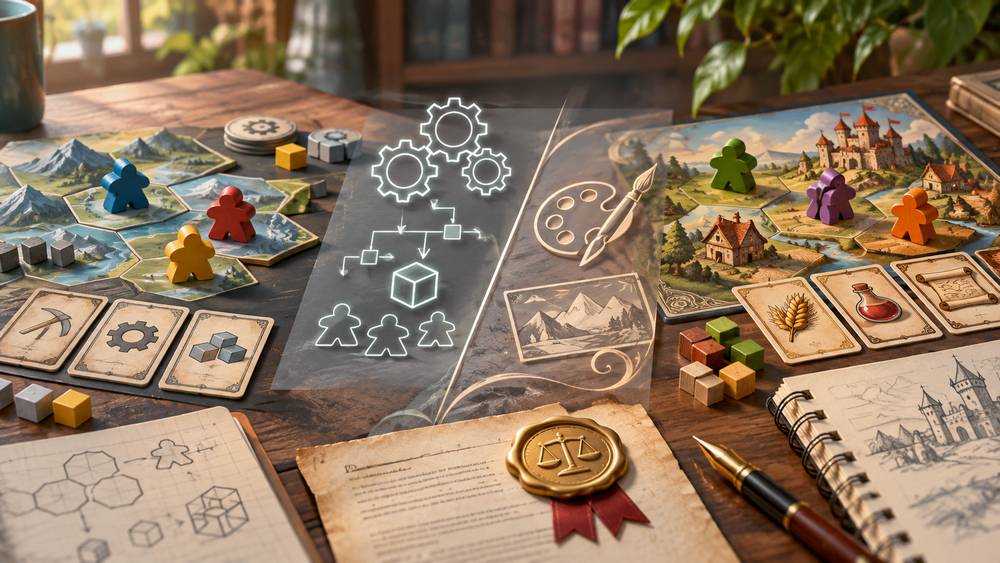
Game mechanics are the rules and systems that determine how a game functions. They describe what players can do, how actions are resolved, and how decisions influence the game’s outcome.
Worker placement, deck-building, dice drafting, resource conversion, and action-point allocation are familiar examples.
A designer might develop an original variation of these systems, combining them in ways that create an entirely different experience.
However, copyright generally protects creative expression, not the underlying methods or systems themselves.
The World Intellectual Property Organization (WIPO) makes this distinction clear: copyright protects the expression of ideas rather than procedures, methods of operation, or concepts.
For board game designers, this means that inventing a clever mechanic does not automatically grant exclusive copyright over its use.
Can Someone Use Your Mechanic in Another Game?
Consider a hypothetical game where players secretly select three actions, reveal them simultaneously, and resolve conflicts according to a priority system.
Another designer creates a different game using the same action-selection procedure, but with a new theme, different artwork, independently written rules, and original components.
The shared procedure alone would generally not establish copyright infringement.
The situation changes if the second designer reproduces substantial protected elements, such as original rulebook passages, illustrations, or distinctive creative content.
An important distinction is that the text explaining a mechanic may be protected, while the mechanic itself generally is not.
This is particularly explicit in guidance from the United States Copyright Office, which distinguishes the written and visual expression of a game from its methods of play.
A Real Legal Case: BANG! and Legends of the Three Kingdoms
One of the most relevant examples comes from the American lawsuit DaVinci Editrice v. Ziko Games.
The dispute concerned the card games BANG! and Legends of the Three Kingdoms. Both used remarkably similar gameplay structures, including hidden player roles, attacks, character abilities, and victory conditions.
DaVinci Editrice argued that protected elements of BANG! had been copied.
In April 2016, the U.S. District Court for the Southern District of Texas ruled in favor of the defendants.
The court distinguished gameplay procedures from potentially protectable expressive elements. Although the games shared extensive mechanical similarities, the court found insufficient unlawful similarity in the protected expression at issue.
The decision illustrates an important principle: two games can operate in very similar ways without necessarily infringing copyright.
However, this was a United States decision, not a universal ruling applicable to every country.
What About European Copyright Law?
The European approach also distinguishes ideas and methods from original creative expression.
The European IP Helpdesk explains that game mechanics themselves generally fall outside copyright protection, while original rulebook text and artistic elements may qualify.
In Greece, Law 2121/1993 protects original intellectual creations, including literary and artistic works. It does not automatically turn a gameplay procedure into exclusive intellectual property.
There are additional legal considerations. Trademarks, registered designs, confidentiality agreements, and, in exceptional technical circumstances, patents may offer different forms of protection.
These rights have separate requirements and should not be confused with copyright.
How Should Designers Protect Their Work?
Even when a mechanic cannot be copyrighted, documenting its development remains valuable.
Keep dated versions of your rules, prototype files, design notes, and playtest reports. These records can help establish how your project evolved, particularly if a disagreement involves protected content or contractual obligations.
When sharing unpublished material with collaborators, consider appropriate confidentiality agreements and clearly define how the information may be used.
If a publisher or another designer adopts your mechanic, examine the complete circumstances before assuming infringement. Did they copy only the functional system, or did they also reproduce protected creative material?
That distinction matters.
Innovation Is More Than Ownership
Board games develop through experimentation, adaptation, and the combination of existing ideas.
If every familiar mechanism were exclusively owned by one designer, much of modern board game development would become difficult.
This does not diminish the work involved in creating an innovative mechanic. It simply means that legal protection and creative originality are different questions.
You may not be able to copyright how your game works, but you can protect original ways in which your game is expressed.
Understanding that boundary helps designers share their work, collaborate responsibly, and recognize when similarities raise genuine intellectual property concerns.
References & Further Reading
- WIPO — Copyright Protection
- European IP Helpdesk — Board Games’ Revival and Its Intellectual Property Challenge
- U.S. Copyright Office — Games
- DaVinci Editrice v. Ziko Games — U.S. District Court Decision, 2016
- Hellenic Copyright Organization — Law 2121/1993
Disclaimer: This article provides general information about intellectual property law. Legal protection varies by jurisdiction and individual circumstances. It does not constitute legal advice.
Dice Peak — Board Game Development & Playtesting

