Understanding what the law protects, what it doesn’t, and how to safeguard your work.
You’ve spent months, perhaps even years, developing a board game. You’ve designed the mechanics, refined the rules, built prototypes, and tested countless variations. Now you’re ready to show it to other people.
But there’s a question that often comes up: What if someone steals my idea?
It’s a reasonable concern, especially for independent designers preparing to share their work with playtesters, publishers, or potential collaborators.
The answer, however, isn’t quite as straightforward as you might expect.
Can You Copyright a Board Game Idea?
No. Copyright generally protects the original expression of an idea, not the idea itself.
This distinction is fundamental to intellectual property law and applies to board games just as it does to books, films, and other creative works.
Imagine you’ve designed a game where players manage competing medieval trading companies. They collect resources, establish trade routes, negotiate agreements, and earn victory points.
Another designer could develop a game around the same general concept without necessarily violating your copyright.
What they cannot freely do is reproduce protected elements of your creation, such as original rulebook text, illustrations, or other copyrightable material, without permission or another valid legal basis.
According to the World Intellectual Property Organization (WIPO), copyright protects how ideas are expressed rather than the concepts or systems behind them.
What Parts of Your Game Are Protected?
Although your game’s underlying concept is not protected by copyright, several elements may qualify for legal protection.
These include:
- Rulebooks: The original wording, explanations, and creative presentation of your rules.
- Artwork and illustrations: Original character illustrations, card artwork, and other visual creations.
- Characters and storytelling: Original narrative content and sufficiently developed creative characters.
- Graphic design: Original visual elements of boards, cards, and other components.
- Game titles and logos: These may qualify for trademark protection, depending on their distinctive character and applicable registration requirements.
Game mechanics require particular attention.
Common mechanics such as worker placement, deck-building, dice rolling, and resource management are generally not protected by copyright.
This means another designer may use similar mechanisms, even in a game with a comparable theme.
That doesn’t automatically make their game a copy of yours in the legal sense.
When Does Inspiration Become Copying?
Board game design rarely happens in isolation. Designers learn from existing games, adapt familiar mechanisms, and combine established ideas in different ways.
Consider two games that use identical resource-management mechanisms but have different artwork, rules text, and thematic presentation.
Their similarities may reflect common design principles rather than copyright infringement.
Now imagine a game reproducing another designer’s illustrations, substantial portions of their rulebook, and original narrative content.
That raises a very different legal question.
Similarity alone is not enough to establish copyright infringement. What matters is whether protected creative expression has been unlawfully copied.
Other rights, including trademarks, design rights, contractual obligations, and trade secret protections, may also become relevant.
There’s an important distinction between something that feels creatively unfair and something that violates an enforceable legal right.
How Can You Protect Your Board Game?
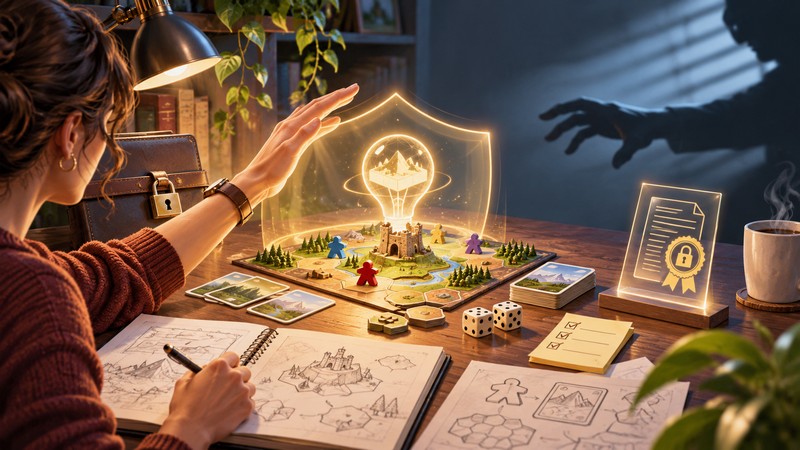
There is no single document that guarantees nobody will copy your game. However, you can take practical steps to protect your work and strengthen your position if a dispute occurs.
Keep a development history. Save dated versions of your rulebook, card files, prototype photographs, playtest reports, and design notes. These records may help demonstrate how your game developed over time.
Document your work. Where appropriate, use reliable timestamping or other recognized methods to establish when particular files existed. A timestamp is evidence of existence, not proof that you own every right in the material.
Be selective about what you share. During early development, provide collaborators with the information they genuinely need. Consider confidentiality agreements when sharing valuable unpublished material.
Read submission agreements carefully. Before approaching a publisher, review its submission guidelines and terms. Never assume that sending a prototype automatically establishes a confidential relationship.
Clarify ownership with collaborators. When working with illustrators, developers, or co-designers, establish in writing who owns the resulting creative work and which rights each party may exercise.
These precautions cannot eliminate every risk, but they can prevent avoidable misunderstandings.
Should You Be Afraid to Show Your Game?
Protecting your work matters. So does allowing it to develop.
Board games need testing, discussion, criticism, and repeated refinement. Keeping a prototype permanently hidden may reduce exposure, but it also prevents you from receiving the feedback needed to improve it.
The goal shouldn’t be to avoid sharing your work altogether.
It should be to understand what you own, document what you create, and share your game responsibly.
Intellectual property protection is one part of professional game development. Knowing its boundaries allows you to make informed decisions without letting the fear of copying prevent your project from moving forward.
Ultimately, a board game is more than an interesting idea. Its value also lies in the creative work, testing, refinement, and countless decisions that turn that idea into a complete experience.
References & Further Reading
- World Intellectual Property Organization (WIPO) — Copyright Protection
- European IP Helpdesk — Board Games and Intellectual Property
- U.S. Copyright Office — Games
- Hellenic Copyright Organization — Timestamping
- WIPO — Trade Secret Protection
Disclaimer: This article provides general information about intellectual property. Legal protection varies by jurisdiction and individual circumstances. It should not be considered legal advice.
Dice Peak — Board Game Development & Playtesting

